
New York County Arrests Today
No NYPD or DOC feed names every person booked in Manhattan within 24 hours. The NYC DOC Person in Custody Lookup comes closest, yet it answers one narrow question. It tells you whether someone entered city correctional custody, nothing more. An arrest can happen without any DOC commitment at all. NYPD might issue a desk appearance ticket. Bail could be posted quickly, or a judge may order release on recognizance before commitment occurs. Time spent in police lockup also stays outside the DOC system.
Follow the official record chain instead. NYPD creates the arrest and processing record first. Criminal Court then handles arraignment and sets the terms of release. DOC builds a custody record only when a person is actually committed. A later state sentence shifts the search to New York State DOCCS, while federal and immigration custody run on separate systems entirely. A blank DOC result never proves that no arrest took place.
Check Manhattan Arrests Step by Step
Begin with the custody system only when you hold a name or official identifier. The search was built for one person, not for browsing a daily roster. It does accept alternates, and a DOC book-and-case number differs from an NYPD arrest key. When the lookup fails, work the chain step by step. Avoid repeating a broad name query.
- Open the official DOC direct lookup. Enter NYSID or Book & Case Number when available; otherwise enter first and last name.
- Read any match as current NYC DOC custody and basic case information. Check identifiers carefully when names are common.
- If no match appears, allow for police processing and DOC's stated entry delay. Consider whether the person could have been released before commitment.
- Check eCourts and WebCriminal for an eligible case after arraignment. A new filing can also lag, and sealed or excluded cases may not appear.
- For the underlying incident record, submit a focused request through NYC OpenRecords to NYPD or DOC with the name, date, precinct, and known identifiers.
The New York County recent arrests hub gathers the county-wide paths for records, custody, courts, and photos. For how a case truly ended, rely on the court disposition rather than the first charge label.
The official DOC lookup interface displays every field a named custody check can use.
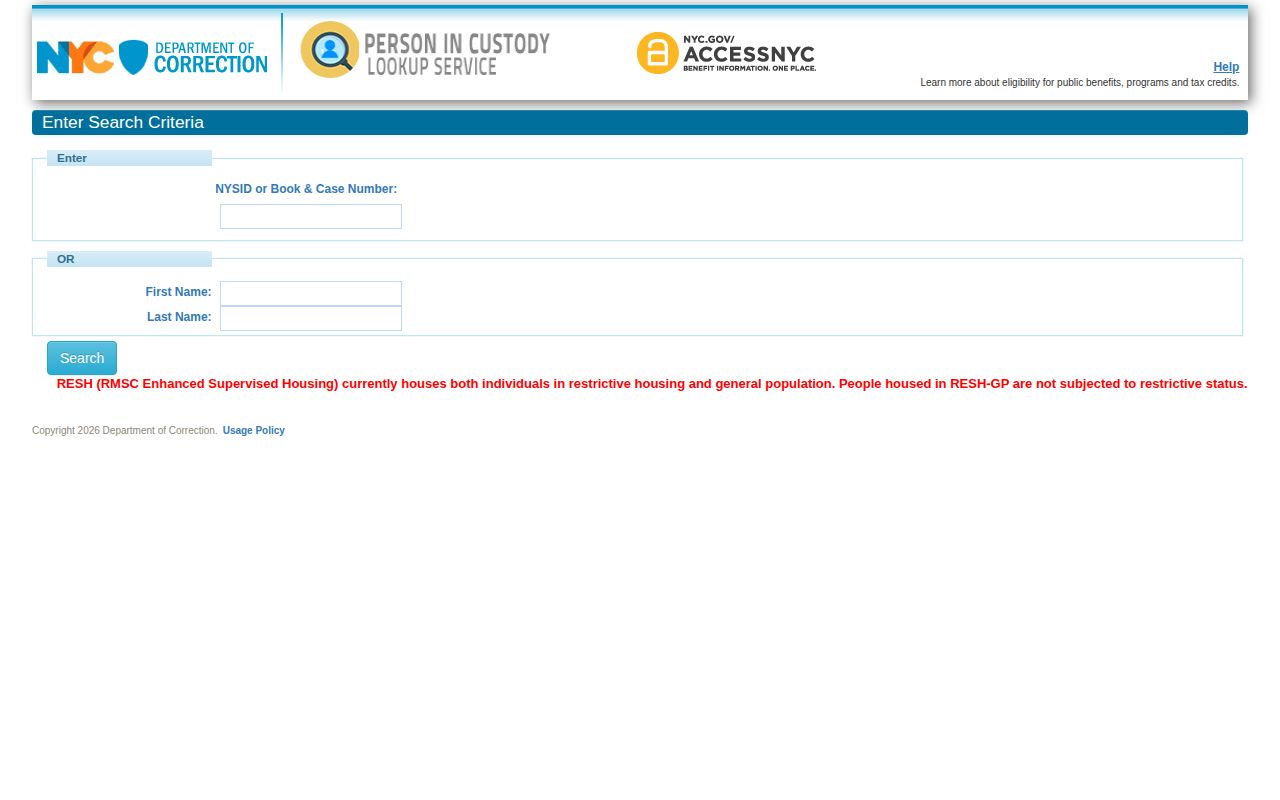
The DOC search page itself makes the point plain: it offers a specific-person custody lookup, not a scrollable daily arrest feed.
What Same-Day Sources Actually Show
With no official daily list, keep each field tied to its own source. Merging NYPD incident data with DOC custody fields would build a record no agency actually publishes. The table below separates what is supported from what is missing.
| Source or field | What it means |
|---|---|
| DOC name, NYSID, Book & Case Number | Search keys for current DOC custody and basic case information, not a 24-hour arrest list. |
| NYPD arrest key and arrest date | Incident fields in lagged Open Data products, not a live named feed. |
| Offense, borough, precinct, jurisdiction | Coded NYPD dataset fields that describe an incident. Manhattan uses the borough code M. |
| Charge and disposition | The initial charge may change. Court records and a Certificate of Disposition provide later case status. |
| Booking photograph | No public photo field was observed in DOC lookup, and no official same-day photo feed was found. |
| Bond or release status | Not promised as a DOC search field. Confirm release conditions through the court record or clerk. |
The DOC lookup help view explains the official interface and its search context.
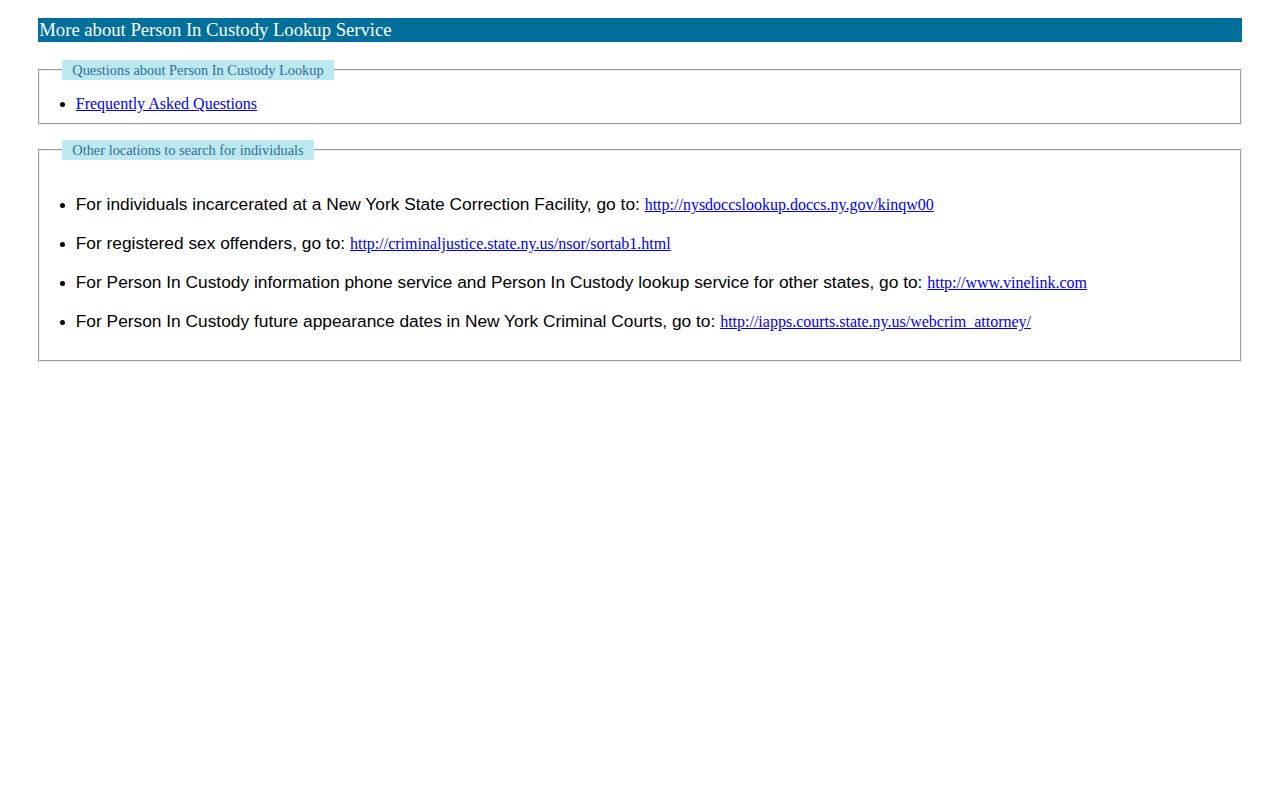
The help page pays off when a name search returns several possible matches. Use a book-and-case number or NYSID to narrow it down.
New York Arrest Fallback Chain
A same-day search should follow the stage the person has likely reached. During NYPD processing, a precinct or an attorney may hold details. DOC itself may lack them. After arraignment, WebCriminal or the right Criminal Court clerk can identify the court part and next date. That applies to an eligible public case. Once DOC commitment happens, the person-in-custody lookup and NYC VINE take over. After a state sentence, switch to the official New York State inmate lookup. Skip the city roster.
When records stay offline, NYPD and DOC both accept Freedom of Information Law requests. You can file through NYC OpenRecords or their own records-access routes. Include enough detail to locate the file. Give the full name, date of birth when appropriate, arrest date, Manhattan precinct, NYSID, and Book & Case Number if known. A request may be granted, redacted, or denied under privacy, active-investigation, safety, sealing, or other lawful exemptions. A photo is never guaranteed.
Selected NYPD newsroom notices can describe a major event. Still, they are editorial public-information releases, not a complete arrest list. The Weekly Arrest Log shows how to use those multi-day releases and longer-horizon sources. Do not mistake them for a blotter.
Note: Custody, an arrest incident, and a court case are linked stages, yet each is a separate record.
New York Arrest Charges Can Change
An arrest report captures what police alleged at the start. Prosecutors may amend or drop charges. A judge can dismiss a count. Or the case may close through a plea, acquittal, or another disposition. New York City Criminal Court runs arraignments. It also handles misdemeanors, lesser offenses, and early felony proceedings. Its file carries a later and very different view than the arrest entry.
Use WebCriminal for eligible pending cases. For the official outcome, request a Certificate of Disposition from the relevant court. Some cases never appear online. They may be sealed, involve a youthful offender, have not been entered yet, or fall under another exclusion. Absence from a public portal proves nothing about the result.
Why New York Arrest Results Lag
Timing is the real problem, not a feed refresh schedule. The gap runs from arrest to police processing, then arraignment, then DOC commitment. NYC DOC warns that 48 hours or more can pass before a committed person reaches DOC housing and shows up in the database. There is no hourly refresh promise, fixed weekend rule, or same-day roll-off time. So any claim that Manhattan bookings post at a set hour would be unsupported.
That lag matters for custody alerts too. VINE tracks people once they are in DOC custody. It does not watch NYPD precinct lockups. Juvenile detention and federal facilities fall outside its scope too. The same goes for people released by desk appearance ticket, bail, or recognizance. An alert service cannot replace the first confirmation call. The VINELink Inmate Check works best after DOC custody is established.
The city lists no official NYC jail-booking app. Crime Stoppers handles tips and wanted information. Notify NYC and NYC311 serve broader public-notice purposes. None of them is a person-level booking feed. That distinction keeps a public-safety app from being mistaken for a daily arrest roster.
Write down what you searched. Note the spelling, identifier, source, and time. A later result may simply reflect a normal move from police processing to court and DOC custody. When an agency record is needed, a precise FOIL request beats a broad demand for all arrests. Name the Manhattan precinct and the approximate arrest date when you know them. Ask the agency to explain any denial or redaction under the applicable law.